
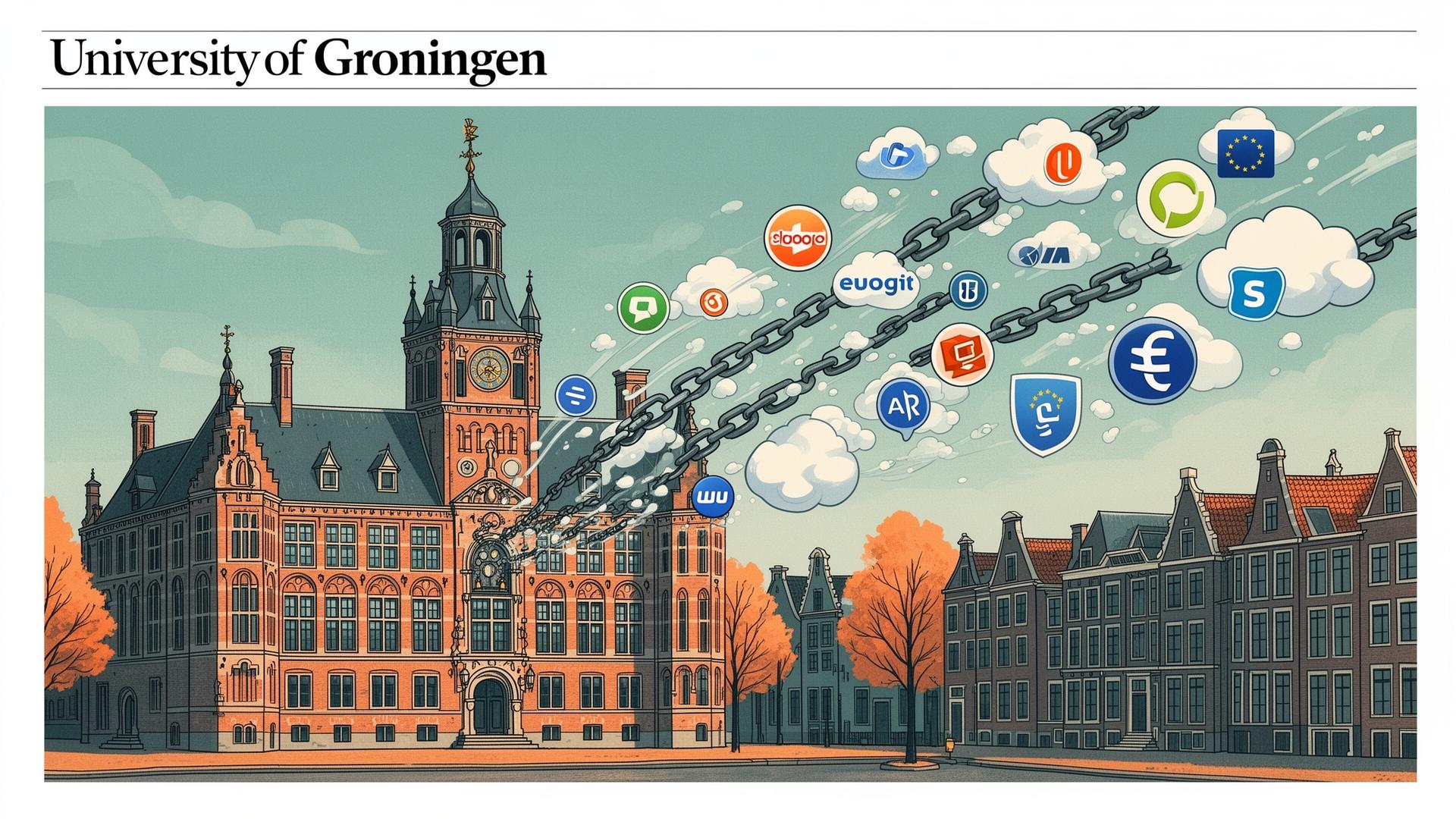
Out of Big Tech by 2030 — a Dutch frontrunner
The University of Groningen (RUG) wants to run its IT without US Big Tech by 2030. With 7,200 staff, 33,000 students and an IT estate "soaked" in American software, it is one of the first Dutch institutions to hard-code digital autonomy into policy. The board adopted the plan in May 2025 and the phase-out has been running ever since.
"If you really look closely, Big Tech is already everywhere", says CIO Nolda Tipping-Griffioen in Dutch newspaper FD. "It's spaghetti — you pull on one strand and everything comes loose."
Why this matters: RUG is not a fringe case. If a large international research university can show it can be done — off Microsoft, Google and AWS — that shifts the norm for the entire Dutch public sector.
The trigger: a Doge email and a 'kill switch'
The slow-burning discomfort — rising licensing costs since Covid, worries about what Big Tech does with research data — became urgent after an email from Doge, the US agency briefly led by Elon Musk. It asked Dutch universities about ties to "communist or socialist" parties and whether female staff were sufficiently protected from "feminist ideas". An unwelcome answer would mean US-funded scientists could no longer collaborate with the institution.
Shortly after, an International Court of Justice judge was cut off from his email account at the request of the US government. "That's just a kill switch", says Tipping-Griffioen. "We have professors here saying things Trump probably doesn't like. That was another reason to say: we need a Plan B ready."
It's everywhere — including where you can't see it
In a series of workshops, staff and academics mapped RUG's IT estate — not just the obvious pieces (mail, storage), but the hidden ones. The learning platform Brightspace, used by many Dutch universities and itself Canadian, turns out to run on Amazon servers. Even non-American citation software collects data on researchers' reading behaviour.
Oskar Gstrein, associate professor of human dignity in the digital age and one of the plan's initiators, calls this sphere transgressions: the logic of commercial tech leaking into the academic sphere. "We are increasingly working for the infrastructure Big Tech builds for us. When we do research, we generate data they use to train language models. When we teach, we train students to become users of their products."
Awareness, carrots, no sticks
You can't force university staff to switch software. So RUG opted for an awareness campaign: a small fair where alternative vendors presented, sessions about dependency risks. "The carrot works better than the stick here", says Tipping-Griffioen.
An unexpected upside: more in-house open-source expertise than expected. IT staff who already knew their way around open-source tools but never had the space to use that knowledge can now step forward.
First concrete steps: Mistral and Nextcloud
Concrete replacements are still limited, but telling. RUG picked France's Mistral for AI chat instead of OpenAI or Google. "It's easier to do something new right than to repair something old", says Tipping-Griffioen. A caveat: Mistral still runs largely on US cloud — "a little better than fully American", Gstrein admits.
Through Dutch sector body Surf, RUG is also part of a pilot with Germany's Nextcloud — a European open-source alternative to Google Drive and OneDrive. Same functionality (file sharing, document collaboration), but on its own servers. The French Ministry of Education is migrating to the same vendor.
Tip: Our directory and categories list European alternatives for almost every American product RUG still uses today.
The acid test: 28 contracts and a double bill
The genuinely hard phase is still ahead. A major workplace contract expires at the end of 2026. Tipping-Griffioen does not expect it to be replaced directly by an open-source alternative like Linux: there are 28 different contracts with different terms, and swapping everything at once is too big a risk for teaching and research continuity.
At some point there will inevitably be a period where old and new systems run in parallel — at double cost. "Do we really want to invest that money? That will be the question." Her core argument for pushing through: Big Tech exploits dependency. Once locked into a Microsoft or Google ecosystem, you have little leverage when licensing costs rise — and they keep rising. In the end, she expects, switching will be cheaper than staying.
Nextcloud: 'pain and discomfort come with the territory'
For European vendors the momentum is unprecedented. Dutch Nextcloud co-founder Jos Poortvliet: "Suddenly we were in conversations everywhere." But he warns: any IT project is hard, one in three fails. "People need to adjust. That has nothing to do with product quality — something always goes wrong."
Poortvliet wants Nextcloud to reach a level where choosing a European alternative is "not a career risk" for CIOs or CTOs. That needs more market share, more name recognition — and realism on the buying side. "People say we have to offer everything Microsoft has. We can't, and we don't want to. Is it really that strange to buy from more than one supplier?"
Students as a flywheel
RUG is trying to keep momentum nationally — through Surf, through Universities of the Netherlands, and through rector magnificus Jacquelien Scherpen, who carries the topic into a digital commission. According to Gstrein, students are an underestimated lever: "If we teach our students to work with other software, we influence the demand side. That accelerates the development of alternatives."
Optimism prevails. "And if in 2030 we are still using American Big Tech somewhere", Tipping-Griffioen concludes, "at least it's a conscious choice. Not because we didn't know we were dependent."
Sources
- FD: Rijksuniversiteit Groningen wil van big tech af, maar dat valt niet mee — 'Het zit overal' (Dutch, paywall)
- RUG Research Portal: clipping of the FD article
- Npuls Edtech Community: How Nolda Tipping-Griffioen started the movement inside RUG
- Dagblad van het Noorden: University wants to be free of Big Tech by 2030
